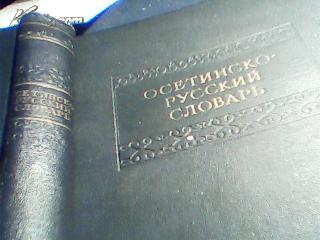
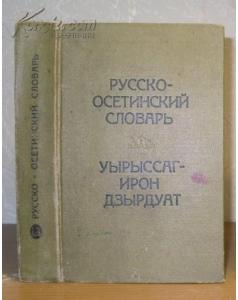
Ossetic belongs to the Northern subgroup of the Eastern-Iranian group of the Indo-European family of languages. Thus, it is genetically related to the other Eastern-Iranian languages, e.g. Pashto and Yaghnobi.
From deep Antiquity (since the 7th-8th centuries B.C.), the languages of the Iranian group were distributed in a vast territory including present-day Iran (Persia), Central Asia, and Southern Russia. Ossetic is the sole survivor of the northeastern branch of Iranian languages known as Scythian. The Scythian group included numerous tribes, known in ancient sources as the Scythians, Massagetae, Saka, Sarmatians, Alans and Roxolans. The more easterly Khorezmians and the Sogdians were also closely affiliated, in linguistic terms.
Ossetian, together with Kurdish, Tati and Talyshi, is one of the main Iranian languages with a sizeable community of speakers in the Caucasus. It is descended from Alanic, the language of the Alans, medieval tribes emerging from the earlier Sarmatians. It is believed to be the only surviving descendant of a Sarmatian language. The closest genetically related language is the Yaghnobi language of Tajikistan, the only other living member of the Northeastern Iranian branch. Ossetic has a plural formed by the suffix -ta, a feature it shares with Yaghnobi, Sarmatian and the now-extinct Sogdian; this is taken as evidence of a formerly wide-ranging Iranian-language dialect continuum on the Central Asian steppe. The Greek-derived names of ancient Iranian tribes in fact reflect this pluralization, e.g. Saromatae (Σαρομάται) and Masagetae (Μασαγέται).
There are two important dialects: Iron and Digor—the former being the more widely spoken. Written Ossetian may be immediately recognized by its use of the æ, a letter to be found in no other language using the Cyrillic alphabet. A third dialect of Ossetic, Jassic, was formerly spoken in Hungary. The overwhelming majority of Ossetes speak the Iron dialect, and the literary language is based on it. The creator of the Ossetic literary language is the national poet Kosta Xetagurov (1859-1906).
Writing system


The first page of the first issue of the Ossetic newspaper "Ræstdzinad". Sjögren's Cyrillic alphabet. 1923
Prior to the Russian conquest, Ossetic was reportedly an unwrittenlanguage. After the Russian conquest Ossetians used Cyrillic script:the first Ossetic book being published in Cyrillic letters in 1798. Atthe same time Georgian scriptwas used in some regions to the south of Caucasian mountains: in 1820I.Yalguzidze published an alphabetic primer, modifying Georgianalphabet with 3 special characters. That Georgian-based script was inuse in the territory of South Ossetia (Georgian autonomy) in 1937–1954.
The modern Cyrillic alphabet was created by a Russian scientist of Finnish origin Andreas Sjögren in 1844: there were separate letters for each sound in that alphabet (much like in the modern Abkhaz alphabet). After a brief experiment with the Latin alphabet, Soviet authorities returned to the Cyrillic alphabet, with digraphs introduced to replace most diacritics.
The modern Cyrillic alphabet, used since 1937, with values for the Iron dialect in the IPA. Letters in parentheses are only needed for Russian loans:
In addition, the letters Ё, Ж, Ш, Щ, Ъ, Ь, Э, Ю, Я are used totranscribe Russian words. An alternate alphabet used for a time innewspapers reduced most of the digraphs to ligatures, and had separate letters у and ў for the sounds and [w].The Latin alphabet (used 1923-1937):
In addition, the letters Š and Ž are used to transcribe Russian words.The "weak" vowels æ IPA: [ɐ] and ы [ɨ] are extremely common in the language, a feature it shares with Persian.
[
本帖最后由 hongwei0315 于 2008-8-29 15:09 编辑 ]


 等 1 位声友




 对那片儿不感兴趣